
Caring About Baseball
Or, on Being a 10-year-old Mariners Fan Trapped in a 34-Year-Old Body
As I begin writing, the Seattle Mariners have gone up two games to none against the Toronto Blue Jays in the American League Championship Series. They won twice in Toronto, and now they play three games at home. They have five chances to win two games. If they succeed, they’ll advance, for the first time in their 49 seasons as a club, to the World Series. They are the only team in the Majors who has yet to get that far.
I wouldn’t put it past them to blow this opportunity. To be a Mariners fan is to be intimately acquainted with blown opportunities. Mountains of blown opportunities, piled up over the decades. I can’t predict what will happen, but I can say that they have put themselves in a fine position to win the pennant and square off against the Dodgers or the Brewers for the championship. And I can tell you that I will be watching every last game.
You may not care about baseball, or sports in general. How can you care about sports, you might think, when our country seems to be falling apart? Or maybe you care deeply about baseball, and for that reason you refuse to care about Major League Baseball, such a commercialized version of the game, with absurd salaries and a free agency system that sends players bouncing from team to team throughout their careers. New rules in recent years around the pitch clock and the size of the bases and that abominable “ghost runner” who starts on second base in extra innings (thankfully not during the playoffs) are all designed to make baseball a faster, zippier game, friendlier to our impoverished attention spans.
All valid criticisms. As for me, I cannot help but care. And this, above all, is why I am writing this essay: to try to understand why the Seattle Mariners can elicit such extreme emotions in me. Why my heart rate goes berserk when Andres Muñoz must hold a one-run lead for three outs and the leadoff man gets on base. Why I, an otherwise reasonable person, scream myself hoarse when Jorge Polanco singles home the winning run in the bottom of the fifteenth.
Twice this postseason, the Fox Sports telecast has cut to a shot of a guy in the crowd, about my age, decked out in Mariners merch, crying. I don’t mean sad crying. Both times, the Mariners had just scored decisive runs. These men are crying because they have been waiting so long. (Take that, Tom Hanks!)
We have been waiting so long: twenty-four years, nearly a quarter of a century, since their last division title, their last ALCS. When, in 2022, the Mariners made it to the playoffs for the first time in twenty-one years, they ended the longest playoff drought in the four major men’s professional sports (NBA, NFL, NHL, MLB). After some early excitement that postseason, they fizzled out against the Astros in the Division Series. Then, in 2023 and 2024, they missed the playoffs by one game. They have gotten painfully close and come up short. “Maybe next year” has become our annual refrain, a bitter joke.
I have tried to convey the gravity of all this to my wife. “Imagine your favorite musician put out a near-perfect album 24 years ago. Every album since has been a disappointment. But they’re about to release another album and all the critics are saying it might be just as good if not better than…” But this is a ridiculous comparison. How do I explain such an elemental attachment to something so inconsequential as a baseball team?
Bless her heart, she has been nothing but supportive of my rekindled obsession. It mystifies her, of course—in much the same way it mystifies me that she can watch a 3-hour YouTube video essay on the warped sexual politics of the Twilight saga. But as we often remind each other, quoting Mary Oliver, “You only have to let the soft animal of your body love what it loves.”
The soft animal of my body loves Mariners baseball. I grew up in Seattle in the ‘90s and ‘00s, during the first and so far only sustained run of Mariners greatness. This was the heyday of Ken Griffey Jr. (“The Kid”), Randy Johnson (“The Big Unit”), Alex Rodriguez (“A-Rod”), and Edgar Martinez (just plain “Edgar”)—all future hall-of-famers. I don’t remember the 1995 playoffs, when Edgar hit the extra-inning, walk-off, come-from-behind double that saved baseball in Seattle. I was 4. But I grew up with the legend of that season, and I have some dim memories of catching a few games at the Kingdome. Much more indelible was watching the Kingdome’s implosion on live TV.
I didn’t take an independent interest in the Mariners until the 2000 playoffs. I remember listening to the games on the radio on the floor of my bedroom. I didn’t know the rules, but I could easily understand the emotion in the voices of Dave Niehaus and Rick Rizzs as they told the enchanting story of the unfolding game. The Mariners lost the ALCS that year to the evil Yankees. I was mad about it. When the 2001 season rolled around, I was ready for redemption.
Nobody expected much from the 2001 Mariners. Why should they? We’d been offloading our superstars through the late 90s. Of the big four, only Edgar remained, along with a couple fan favorites like catcher Dan Wilson and outfielder Jay Buhner. We still had Lou Piniella, our loveable, fiery manager. Otherwise it was mostly a new team. The most highly anticipated new player was a 27-year-old Japanese right fielder known mononymously as Ichiro. He’d had phenomenal 9-year career already in Japan, but nobody knew if that would translate to success in the Majors.
It did. Ichiro quickly became a sensation. Fans in the US had never seen someone play baseball the way he did. A left-handed batter with incredible speed, he seemed to be halfway to first base by the time the ball left his bat. He would frequently beat out routine ground balls for infield hits. His defensive abilities were just as spectacular as his hitting. I’ll never forget, early in that 2001 season, when Ichiro threw out Terence Long of the Oakland Athletics, trying to go from first to third on Scott Hatteberg’s single. It looked like Long had it easily, until Ichiro’s laser-like throw to David Bell nailed him. Dave Niehaus’s unforgettable radio call: “I’m here to tell you that Ichiro threw something out of Star Wars down there at third base!”
It’s hard to overstate how good the Mariners were that year—without question, one of the greatest teams to ever play the sport. They were practically unbeatable. When they went 20-5 in April, everyone thought was a fluke. Then they went 20-7 in May, and kept on steamrolling their opponents. Between May 23rd and June 8th they won 15 games in a row. Indeed, they made it to September without losing more than two games in a row, and without having lost a series. They finished the season with 116 wins, tying the all-time record set by the Cubs way back in 1906. Ichiro was our big star, but so many other players had the best seasons of their careers. Eight of our players were selected for the All Star Game—which just happened to be taking place in Seattle that year.
You may have noted the words “we” and “our” creeping into my writing here, as it crept into my speech at 10 years old, referring to the Mariners organization as if I were somehow part of it. It’s a linguistic tic that neatly distills the extent of my identification with this team—and, I should add, not an uncommon habit among fans. We really do feel like we are part of this phenomenon.
And we are. The players will say it themselves—it’s the fans. They couldn’t do it without the fans. The 2001 Mariners sold out nearly every game in their beautiful new 48,000-seat stadium—and the energy at these games was nothing short of electric. I was learning what it felt like to be swept up inside something much greater than myself. I imagine it’s not too different than what a true believer feels in a megachurch.
The right fans, the right players, the right coaches with the right approach to hitting and pitching–all important, but it’s impossible to explain the Mariners’ success in 2001 without acknowledging the presence of some kind of magic. They tapped into some secret force—or, as that year’s slogan had it, “SoDo Mojo”—that made them more than the sum of their parts.
So why didn’t the M’s make it to the World Series that year, let alone win it? By the end of the season, everyone certainly expected them to. There has been speculation among some fans that they would have, if it weren’t for the September 11th attacks. Of course we’ll never know—and even if it were true, it would be pretty far down on the list of that day’s tragic consequences. Still, something had shifted when MLB play resumed a week after the attacks. The M’s lost four games in a row, including a three-game sweep by the Oakland A’s. (It’s easy to forget that the A’s won 102 games that season, which in any normal year would be the best record in baseball; in 2001 it put them a whopping 14 games out of first place in the AL West.) Meanwhile, the nation was now rooting for the Yankees, symbols of a city rising from the ashes. And indeed it was the Yankees who would dispatch the Mariners in 5 games in that year’s ALCS.
To this day, thinking about the 2001 Mariners brings more than a twinge of painful nostalgia. I was 10, just coming into my awareness of myself, discovering what I loved. I loved baseball. I loved the Mariners. Importantly, these were my own discoveries. I do not come from a sports family. I had a few friends who were into baseball, but in most of my memories from that time, I was by myself. So many evenings watching games alone in the basement. I’d mute the TV to practice my sportscasting skills, parroting the language I’d absorbed through all those hours: “And the 2-1 on the way to Ichiro, here she comes… and it’s lined into the gap in right-center field, a base hit! He’s rounding first and headed for second! Up on the ball is Sierra, the throw in is… not in time! Ichiro is aboard with a lead-off double!” So many mornings that summer lying on my butterfly bedspread, reading the sports section, checking box scores from around the league, tracking the league leaders in home runs, hits, RBIs, wins, saves, ERA—always happy to see my favorite Mariners among them. I had an incredible memory for numbers and facts at that age. Well into the 162-game season I realized that I could rattle off the score of every game the Mariners had played so far, in order.
I was deeply superstitious. I would get mad at anyone who “jinxed” a game by confidently predicting the outcome. It didn’t matter whether they were saying “we’ve got this one in the bag” or “we’ll never catch up now.” I had learned the hard way. One day, the Mariners were leading Cleveland 14-2 in the 7th inning. I turned off the TV, thinking the game was as good as over. Cleveland mounted an unprecedented comeback, tying the game in the ninth and then winning it in extra innings. I blamed myself.
When the Mariners were eliminated that October, I was crushed. I screamed. I threw things at the wall. You’d think there had been a terrible tragedy. My dad has admitted to me since that, when he tried watching baseball with me at that age, often it just wasn’t fun. I was too wrapped up in it.
But kids get over things quickly. So our magic season was cut short. We always had next year.
Just as nobody predicted the phenomenon of the 2001 Mariners, no one would have guessed heading into 2002 that 21 years would pass before they would return to the playoffs. In that time, I grew up. I still went to games, lots of them. I even worked at the stadium for a season when I was 17, selling merch at the official Team Store. I cheered when we acquired free-agent sluggers, only to watch them have the worst seasons of their career as soon as they put on Seattle’s white-and-navy uniform. At some point, our magic had deserted us.
I went to college. I learned to be skeptical of American exceptionalism. I started noticing all the nationalist propaganda woven into our sports culture. I abhored the toothless patriotism of it all. I despaired at the wastefulness, the cheap merchandise, the mountains of trash generated by this huge capitalist engine. I questioned everything. How can a team really be a team if the players keep leaving for bigger paychecks elsewhere? When the Mariners traded Ichiro to the Yankees—the Yankees!—in 2012, there were no more members of the 2001 squad left.
Years followed when I barely paid attention. But I could never cut off the Mariners entirely. Jaded as I was, I could not help but get excited whenever they started to play well. There was a pilot flame of belief somewhere deep inside me that refused to go out.
Which brings us to now. That flame has erupted anew. And who, exactly, is this new team that has managed to win me over? One of our young stars, Julio Rodriguez (“J-Rod”), was not even a year old when the Mariners had their best season. And yet, there are continuities with 2001. Dan Wilson, the catcher from that year, is now the team’s manager. Edgar Martinez is one of the hitting coaches. Rick Rizzs still calls games on the radio, and sometimes Jay Buhner joins the broadcasts.
More importantly, the M’s have spent the last several years investing in young talent, not just trading for sluggers but developing players brought up through the Mariners’ “farm” system. The result is that we finally have a team with some cohesion. These guys like each other—you can tell. They have corny rituals, like hoisting a huge trident in the air after hitting a home run, or dancing in a circle every time they win a game. They have a new crop of young stars, none of whom is more important than charismatic catcher Cal Raleigh (“The Big Dumper”) who hit 60 home runs this year, smashing the record for both catchers and switch hitters, tying Babe Ruth for third all time in the American League. While the team this year was nowhere near as dominant as the 2001 Mariners, they surged at the end of the season, at one point winning 17 out of 18 games. In this way, they are more like the 1995 team. And just like in ’95, they won the ALDS in Game 5 with a dramatic extra inning walk-off hit.
Now here we are on the cusp of the unthinkable, and my inner 10 year old has come alive. Thankfully I no longer throw things when the Mariners lose. But I do get upset. It puts me in a sour mood. When they win, I rejoice giddily, and watch the highlights on repeat. And I’ve been digging up old clips from 1995 and 2001, brushing up on my team history. Certainly I have more important things to do, but I just can’t help myself.
It occurs to me that maybe I’m grasping for something to believe in at this moment when it’s so hard to believe in America. When I feel so remote from the mythology of my youth, the 90s “end of history” mentality that promised that everything would get better over time. In retrospect, much of that mythology came crashing down with the towers on 9/11/01. Now, it’s hard to believe that things aren’t getting worse and worse.
So maybe I’m just coping. Maybe the Mariners are a distraction. I’ll take it. It lets me be proud of something. My hometown. My team. I’ve been watching the games at the pub near my house, cheering and commiserating with all these other fans who have come out of the woodwork. We’ve been buying each other beers, laughing at how much we care about this perennially infuriating, boyishly lovable team.
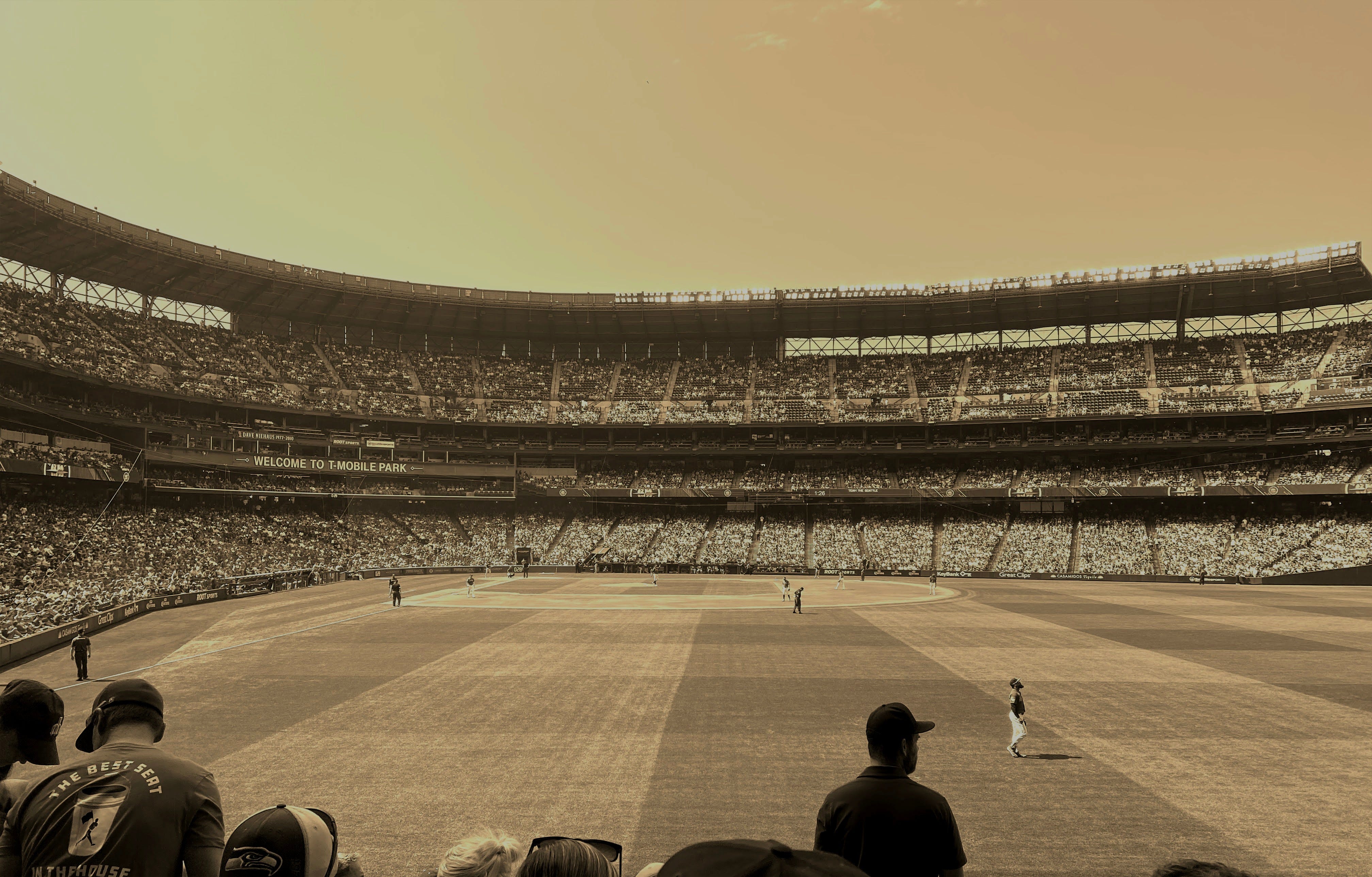
When I started writing this essay, the Mariners had taken a commanding early lead in the series. They returned triumphantly home only to be clobbered in the next two games, 13-4 and 8-2. That’s baseball for you. The energy can turn around so quickly. In games 1 and 2 they were playing great baseball. In games 3 and 4, they looked like a totally different team.
Game 5 starts in a few hours. The M’s have their work cut out for them. They need to summon that old magic and really play as a team. Will they bounce back after two tough games and charge to the finish? Or are we watching them implode like their old stadium? Will we find ourselves sighing “maybe next year” like so many times before? Will today’s 10-year-old fans look back wistfully at 2025 as a fluke of a magic season cut painfully short? Or will they come to see this year as the beginning of a new era of Mariners greatness?
Only time will tell.